Crossbody Strap Length Guide for Crochet Bags
How to measure the right crossbody strap length on your own body, how much shorter to crochet it to allow for stretch, and ways to make a strap adjustable.
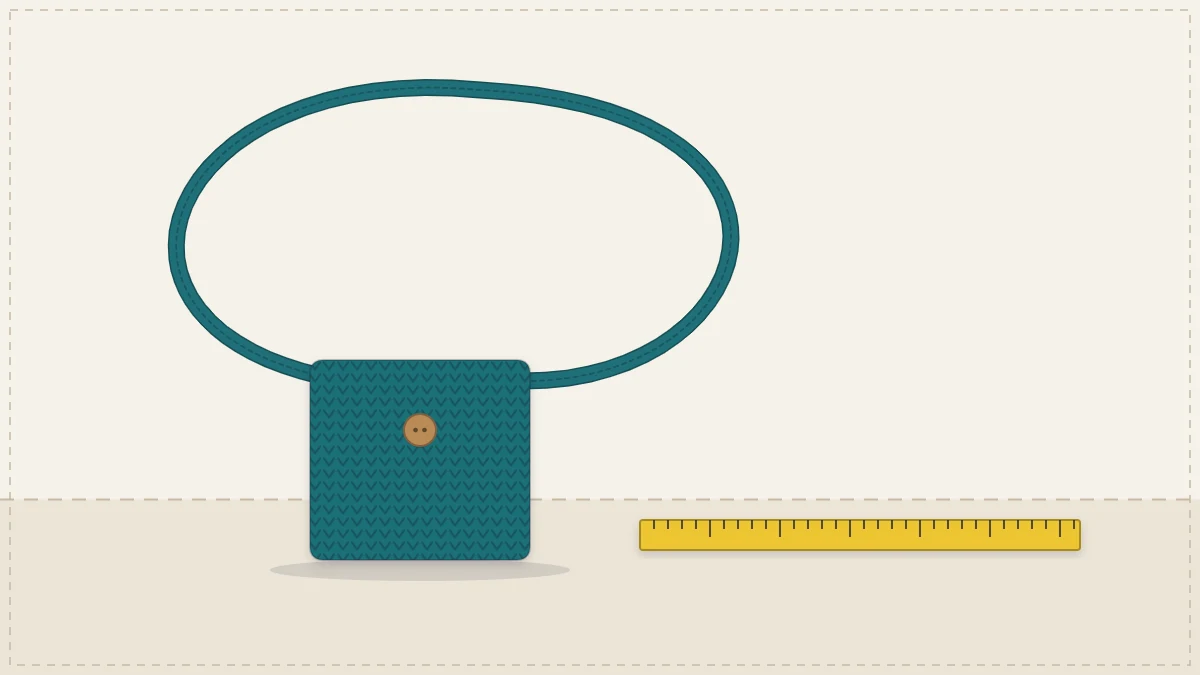
A crossbody strap is the right length when the top of the bag sits at or just below your hip bone and your hand drops into it without reaching. The number that produces that result varies from one person to the next, with height, build and even the coat being worn, so the reliable method is to measure your own body and then adjust for the way crochet behaves.
Strap length and strap drop
Two measurements are used for straps, and mixing them up causes most sizing mistakes.
- Strap length is the strap itself, from one attachment point to the other, laid flat.
- Strap drop is the vertical distance from the top of the strap, where it rests on the shoulder, down to the top edge of the bag.
On a narrow bag the drop is close to half the strap length. On a wide bag the strap ends are far apart, so the same strap gives a slightly shorter drop.
Measure on your own body
- Wear what you would normally wear with the bag. A thick coat can use up a couple of inches of strap.
- Hold the end of a tape measure, or a length of non-stretchy string, at the point on your hip where the top corner of the bag should sit.
- Run it up across your chest, over the opposite shoulder, and down across your back to the same hip.
- Read the number where it meets the starting point. That is your target strap length for a narrow bag.
- If the bag is wider than about 8 in (20 cm), subtract roughly half the bag width, because the bag itself fills part of the loop.
Check it in a mirror and move around. A bag that sits well while standing can bounce against the thigh when walking if it hangs too low, and one that sits too high gets in the way of your arm.
Typical lengths as starting points
The ranges below are common finished measurements for adult bags. Treat them as a place to begin when you cannot measure the wearer, not as standards.
| Carry style | Finished strap length | Approximate drop | Where the bag sits |
|---|---|---|---|
| Hand or elbow carry | 12 to 16 in (30 to 40 cm) | 4 to 7 in (10 to 18 cm) | In the hand or the crook of the arm |
| Short shoulder | 18 to 24 in (46 to 61 cm) | 8 to 11 in (20 to 28 cm) | Tucked under the arm |
| Long shoulder | 28 to 36 in (71 to 91 cm) | 13 to 17 in (33 to 43 cm) | Near the waist, on one side |
| Crossbody | 42 to 52 in (107 to 132 cm) | 20 to 25 in (51 to 64 cm) | At the hip, strap across the chest |
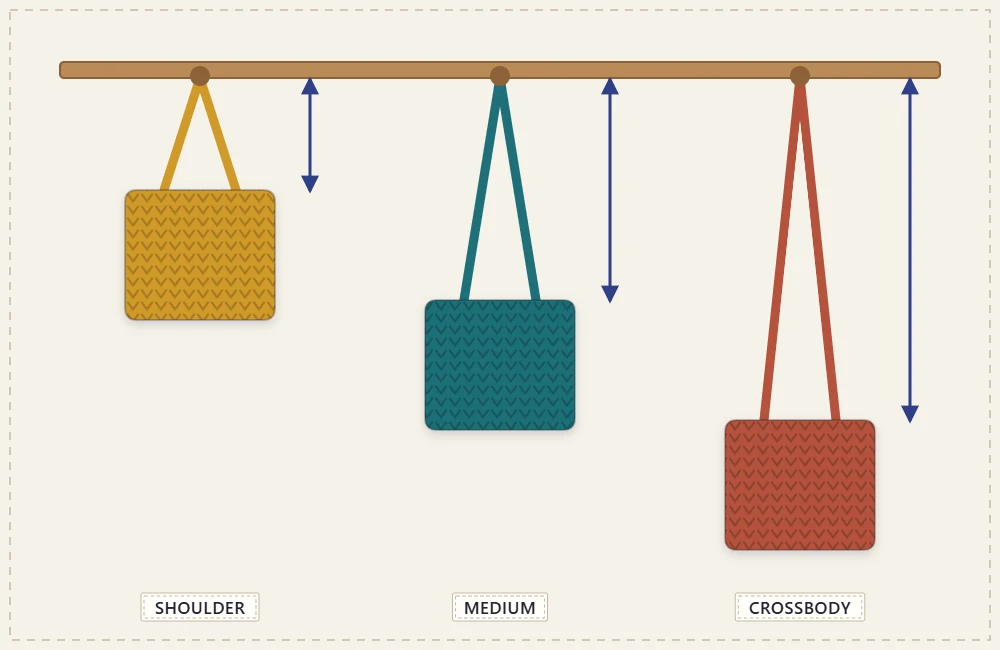
Within the crossbody range, shorter wearers and children usually need the lower end or less, and tall wearers the upper end or more. For a gift, an adjustable strap is safer than a guess.
Why crochet straps grow
Crochet stitches are loops, and loops straighten out under tension. A strap carries the full weight of the bag along its length, so it lengthens and gets narrower at the same time. How much depends on several things:
- Stitch direction. A strap worked the long way, with stitches standing across its width, generally stretches less than one worked in short rows stacked end to end.
- Stitch height. Tall stitches such as double crochet (dc) stretch far more than single crochet (sc) or slip stitch (sl st).
- Fiber. Cotton stretches and tends not to spring back. Acrylic and wool have more give in the first place.
- Width. A thin cord under the same load stretches more than a wide band.
- Load. A phone pouch barely pulls on its strap. A bag holding a water bottle does.
How much shorter to make it
As a rough working rule, make an unlined, unreinforced crochet strap about 10 percent shorter than the finished length you want, and closer to 15 percent for a soft yarn, a loose gauge or a bag that will carry weight. For a 48 in (122 cm) target that means crocheting about 43 in (109 cm). These are estimates, and a quick test replaces them with a real number.
Tip
Before sewing the strap on, pin or tie it to the bag, put in what the bag will usually carry, and hang it from a hook or door handle overnight. Measure it again the next day and adjust the length from that.
Growth can also be reduced at the source. Tight stitches, a ribbon or webbing backing, and a slip-stitched edge all help, and they are explained step by step in the guide to crochet bag straps that do not stretch out. The points where the strap joins the bag take the same strain, so see how to reinforce a crochet bag for strengthening the anchors.
Adjustable options
When the wearer, the season or the load will change, build in adjustment instead of committing to one length.
Knots
Make a cord strap a few inches too long and tie an overhand knot near one end to shorten it. Each knot uses up roughly 2 to 3 in (5 to 8 cm) of a worsted cord. It is the simplest method and suits casual bags.
Two tied halves
Crochet two shorter straps, attach one to each side of the bag, and tie them together at the shoulder in a square knot or a bow. The length changes in seconds, and the knot becomes a design detail.
Buttoned strap
Sew one end of the strap to the bag permanently. Along the last 6 in (15 cm) of the free end, work two or three buttonholes about 2 in (5 cm) apart, each made by chaining 2 and skipping 2 stitches in the middle of a row. Sew a button to the bag at the other side. Each buttonhole gives a different length. Use a sturdy button and sew it through a small backing patch of fabric or felt on the inside.
Slider hardware
A metal slider and a ring let a flat strap adjust the way a ready-made bag strap does. It needs a strap that is thin and firm enough to feed through the slider doubled, so it works best with a narrow sc strap backed with ribbon, or with cotton webbing used in place of crochet for the strap.
Putting it into a pattern
Most patterns give one strap length that fits an average adult. Measure yourself first and change that single number; nothing else in the bag depends on it. The flap crossbody bag uses a flat strap worked the long way, and the crochet phone bag uses a thin cord, so between them they show how both types are measured and sewn on.
Frequently asked questions
What is the difference between strap length and strap drop?
Strap length is the full strap measured flat from one attachment point to the other. Strap drop is the vertical distance from the shoulder to the top of the bag, which is roughly half the length on a narrow bag.
What can be done with a strap that has already stretched too long?
Tie a knot in a cord strap, or unpick one end, fold the extra length to the inside and sew it down again. Backing the strap with ribbon at the same time helps stop it from growing further.
How long should a crossbody strap be for a child?
Measure the child the same way as an adult, from hip over the opposite shoulder and back. Children's straps are often well under the adult range, and a tied or buttoned strap allows for growth.