How to Reinforce a Crochet Bag So It Keeps Its Shape
Where a crochet bag sags and how to stop it: stiff base inserts, a doubled base, stronger strap anchors, a stable top edge and interfacing with a lining.
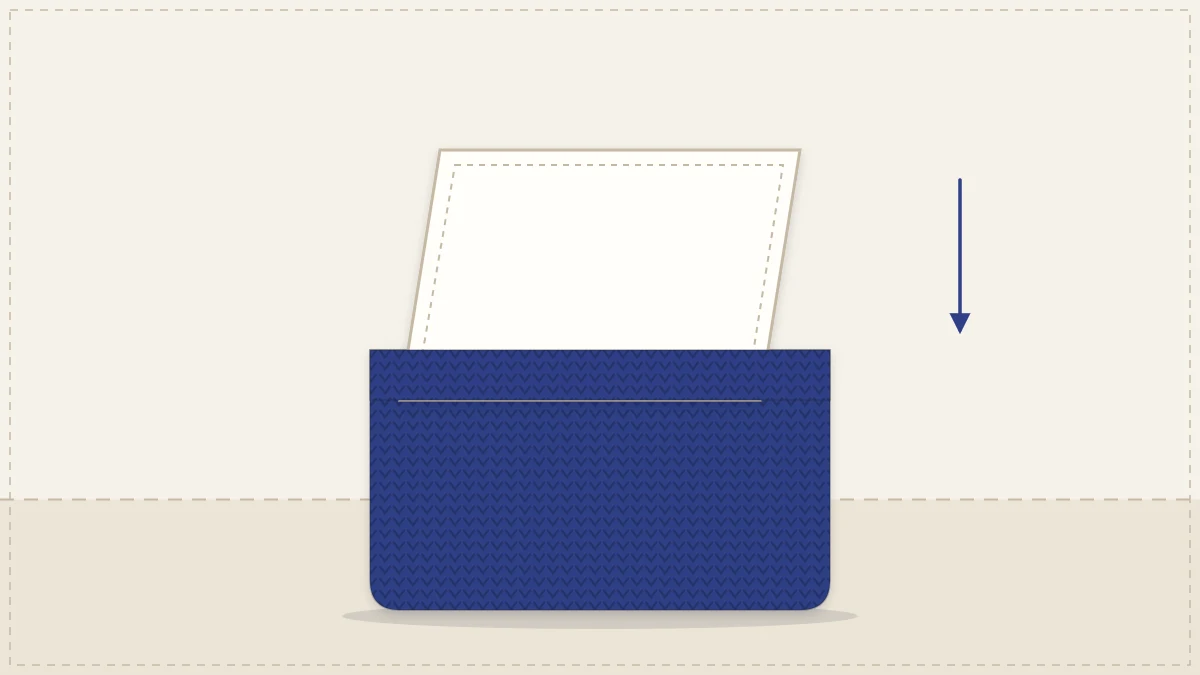
A crochet bag loses its shape in predictable places. The base bows under the load, the strap anchors pull up into points, and the top edge grows wider every time the bag is opened. Reinforcing those three zones does far more than trying to stiffen the whole bag.
Most of the methods below can be added to a finished bag; a few are easier when planned before the first stitch.
Start with a firmer fabric
The cheapest reinforcement is a smaller hook. Dropping one or two sizes below what the yarn label suggests packs the stitches together, which reduces stretch and closes the gaps things poke through. As a test, hold a swatch up to a window and push a fingertip against it: little light should show, and the fingertip should not find its way between stitches.
Stitch choice matters as much as hook size. Single crochet is the baseline, and several denser variations go further; they are compared in the guide to sturdy stitches for bags.
A stiff base insert
A flat insert turns a sagging base into a platform that spreads the weight. Three materials are commonly used.
| Insert | Stiffness | Washable | Notes |
|---|---|---|---|
| Plastic canvas | Firm but flexible | Yes | Cuts with scissors; can be sewn in place through its holes; double it for more stiffness |
| Flexible cutting mat or thin plastic sheet | Firm | Wipe clean | Smooth and thin; round the corners well |
| Fabric-covered board | Rigid | No | Heavy cardboard or bookboard in a fabric sleeve; take it out before washing the bag |
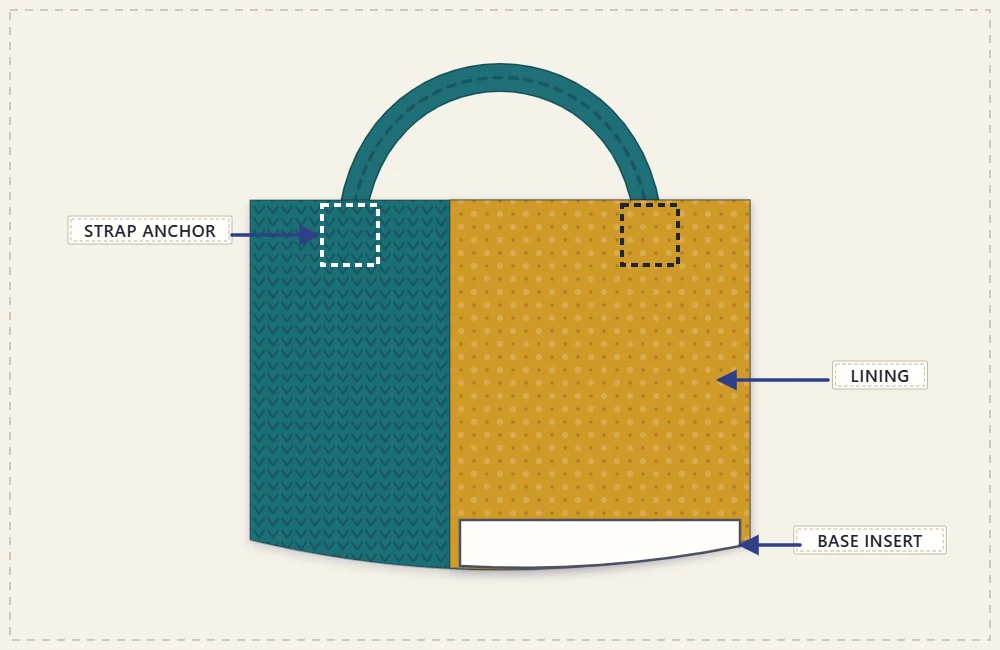
Measure the inside of the finished base, not the pattern dimensions, and cut the insert about 0.25 in (6 mm) smaller on every side so it drops in without stretching the stitches. Round every corner; a sharp corner works its way through crochet. Then choose how to hold it:
- Loose under a lining. The insert sits on the base and the lining goes in over it.
- In a fabric sleeve. A simple fabric envelope keeps the insert clean and can be tacked to the base at four points with sewing thread.
- Between two crocheted bases. The neatest finish for an unlined bag, described next.
Doubling the base
Crochet a second base identical to the first, with the same final stitch count. Hold the two with wrong sides together, slip the insert between them, and join them with one round of single crochet (sc) worked through both layers, matching stitch for stitch. That joining round has the same count as the base, so the sides continue from it as normal.
Even with nothing between the layers, a doubled base is noticeably firmer than a single one, and it hides the ends from the first base inside.
Reinforcing strap and handle anchors
Everything a bag carries hangs from the small patches of fabric where the straps join. Spreading the pull over more stitches is the whole aim.
- Go deeper. Overlap each strap end onto the bag by at least 1.5 in (4 cm) and sew around all four sides of the overlap, then across it diagonally both ways. Stitch through whole stitches, never through a single loop.
- Add a firm band. Work the last three or four rounds of the bag in tight sc, with a hook one size smaller if needed, and attach straps to that band only.
- Back it with a patch. Place a square of felt or tightly woven fabric on the inside behind each anchor and sew through strap, bag and patch together. The patch takes the strain off the yarn.
- Reinforce crocheted-on handles. Where handles are made by chaining across a gap, work at least two more rounds over the chains, and put 2 sc into the stitch at each side of the gap so no hole opens there.
The strap itself also needs to resist stretching; methods for that are in the guides to crochet bag straps and handles.
Tip
Sew anchors with the bag yarn split into thinner plies, or with doubled sewing thread. A full-thickness strand of cotton is hard to pull through dense fabric and tends to leave bulky lumps.
Stabilizing the top edge
An opening that has stretched makes the whole bag look tired. Two finishes keep it at its original size.
Slip stitch round
After the final round, work one slip stitch (sl st) in each stitch around. Slip stitches have almost no give, so they act like a drawn line around the opening. Keep them relaxed enough that the edge lies flat: if the opening pulls inward, redo the round more loosely or with a hook one size larger.
Cord in the edge
Lay a length of cotton cord along the top of the last round and work the final round of sc over it, so the cord is hidden inside the stitches. At the end, overlap the two cord ends by about 1 in (2.5 cm) and crochet over both. The cord cannot stretch, and it gives the rim a rounded, finished look. Do not pull it tight while working, or the opening gathers.
Interfacing and a lining
A fabric lining is the strongest reinforcement for the body of a bag, because woven fabric does not stretch the way crochet does: once the lining is stitched to the top edge, it carries the load and the crochet becomes the outer shell. For more structure, fuse iron-on interfacing to the lining fabric before sewing it. Never iron interfacing onto the crochet itself; the adhesive does not grip the uneven surface and the heat flattens the stitches.
Medium-weight interfacing suits most totes. A bag that should stand up by itself needs a heavier stabilizer, or a sew-in foam layer between lining and crochet. Measuring, cutting and sewing are covered in the guide on lining a crochet bag.
What stiffening sprays can and cannot do
Spray starch and liquid fabric stiffeners make crochet crisp for a while. They are useful for setting a shape after blocking, or for a decorative bag that is rarely handled. They do not add strength. A stiffened strap still stretches under weight, and the effect softens with handling and humidity and usually washes out completely.
Watch out
Some stiffeners leave a pale film on dark yarn. Test on a swatch and let it dry fully before treating the bag.
Choosing what a bag needs
- Small pouches and mini bags: a tight fabric is usually enough; add a lining with interfacing for a boxy shape.
- Everyday totes: base insert, firm top band, patches behind the handles.
- Bags for heavy loads: all of the above plus a full lining and non-stretch straps.
- Mesh bags: leave the body soft, since the stretch is the point, and put the effort into the strap anchors and the top band.
Frequently asked questions
What can be used to stiffen the bottom of a crochet bag?
Plastic canvas, a thin flexible cutting mat or a fabric-covered piece of heavy board all work. Plastic canvas is the usual choice for a bag that will be washed.
Can a finished crochet bag still be reinforced?
Yes. A base insert, backing patches behind the straps, a slip stitch round on the top edge and a lining can all be added after the bag is complete.
Does fabric stiffener stop a crochet bag from stretching?
No. Stiffener makes the fabric crisp but adds no strength, and it softens with use and washing. A lining and non-stretch straps are what limit stretching.