Sturdy Crochet Stitches for Bags That Hold Their Shape
Five dense stitches for firm, low-stretch bag fabric, each with a short recipe, its strengths and weaknesses, and the part of the bag it suits best.

How firm a crochet bag feels depends on two things: how tall the stitches are, and how much air sits between them. Short stitches packed closely together give a fabric that barely stretches and keeps small things inside. Tall, loose stitches give drape, which is welcome in a shawl and a nuisance in a tote.
Five dense stitches cover almost every bag. Each is described here with a short recipe, what it does well and where it falls short.
Single crochet
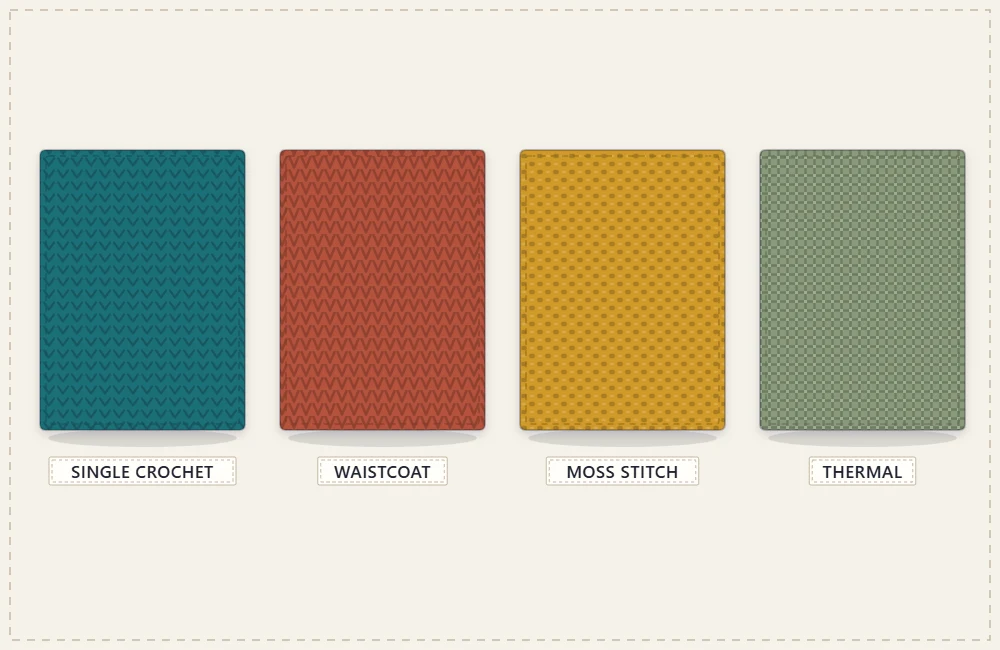
Single crochet (sc) is the shortest ordinary stitch and the standard for bag bodies and bases.
In rows: Chain (ch) any number plus 1. Sc in the second ch from the hook and in each ch across. On every following row, ch 1 (does not count as a stitch), turn, sc in each stitch across.
In the round: Sc in each stitch, either joining each round with a slip stitch (sl st) or working in a continuous spiral with a marker in the first stitch.
For: simple, firm, works in rows and rounds, easy to increase and decrease. Against: slow, and it still stretches somewhat lengthwise under load.
Which loop the hook goes through
Working under both top loops gives the firmest single crochet. Working in the back loop only leaves a ridge on the surface and makes a stretchier, ribbed fabric, so it is best saved for one job: a single back-loop round where the base turns into the sides, which creates a neat fold line.
Half double crochet (hdc) has an extra horizontal strand, the third loop, sitting just behind the top two on the wrong side of the stitch. Working hdc into that strand pushes the top loops forward into a braided ridge. The result is thicker than plain hdc and a good choice for a top band, though it is not as tight as single crochet.
Waistcoat stitch
Also called center single crochet, this is single crochet with the hook inserted in a different place. Instead of going under the two top loops, the hook goes through the middle of the stitch below, between the two legs of the small V on its front.
Recipe: Work in the round without turning, on any number of stitches. Make one round of ordinary sc. On every following round, insert the hook into the center of the V of each stitch, yarn over, pull up a loop, yarn over and pull through both loops.
For: very dense, looks like knitting, almost no stretch in any direction. Against: it only works in rounds worked on the right side, it is hard on the hands, and rounds are shorter than ordinary sc, so the bag takes longer.
Tip
Waistcoat stitch is the one place to go up a hook size and pull each loop up a little taller than usual. If the stitches are tight, the hook cannot get into the V on the next round.
Moss stitch
Moss stitch, also called linen stitch, alternates one sc and one chain, with each sc worked into the chain space below. The stitches lock into a woven-looking fabric that is thinner than single crochet but surprisingly stable.
In rows: Ch an even number. Row 1: sc in the fourth ch from the hook, *ch 1, skip 1 ch, sc in the next ch; repeat from * across. Row 2: ch 2, turn, sc in the first ch-1 space, *ch 1, sc in the next ch-1 space; repeat from * across, working the last sc into the space made by the turning chain. Repeat row 2. With a starting chain of 20, every row has 9 sc.
In the round: On an odd number of stitches, work *sc in the next stitch, ch 1, skip the next stitch* in a continuous spiral. Because the count is odd, the pattern shifts by one on each round and every sc falls into a ch-1 space automatically.
For: quick, uses less yarn, shows off color changes, lies flat. Against: small gaps remain, so it suits lined bags or larger contents, and it has a little more give than plain sc.
Thermal stitch
Thermal stitch is a double-thickness single crochet. Each stitch is worked through a loop of the current row and a leftover loop of the row before it, so the layers overlap like roof tiles. It is the stiffest fabric that can be made with a hook and yarn alone.
Recipe: Ch any number plus 1.
- Row 1: Sc in the second ch from the hook and in each ch across, inserting the hook under one loop of each chain only and leaving the other loop free.
- Row 2: Ch 1, turn. Insert the hook under the back loop of the first stitch and then under the free loop of the foundation chain directly below it, yarn over, pull through both, and finish the sc. Repeat in each stitch across.
- Row 3 and on: Ch 1, turn. Insert the hook under the back loop of the stitch and under the unused loop of the row below, which sits just behind it, and finish the sc. Repeat across.
The stitch count never changes. Each row adds only about half the height of a normal sc row, so the fabric grows slowly and uses roughly twice the yarn.
For: thick, cushioned, almost no stretch. Against: slow, yarn-hungry, heavy in a whole bag, and awkward to shape.
Going down a hook size
The cheapest way to firm up any stitch is a smaller hook. For bags, start one size below the yarn label, and go down a second size if light shows between the stitches of the swatch. Worsted (#4) cotton on a US G-6 (4 mm) hook is a common pairing. When the hook splits the yarn on every stitch or your hands ache after a few rows, the previous size was the right one.
Fiber matters as much as the hook, since no stitch can take the stretch out of an elastic yarn. The guide to the best yarn for crochet bags covers that side.
Which stitch for which part
| Stitch | Density | Stretch | Speed | Best used for |
|---|---|---|---|---|
| Single crochet | High | Low | Moderate | Base, body, handles |
| Hdc in the third loop | Medium to high | Moderate | Fast | Top bands, relaxed bodies |
| Waistcoat stitch | Very high | Very low | Slow | Body of structured bags worked in the round |
| Moss stitch | Medium | Low to moderate | Fast | Body of lined or lightweight bags |
| Thermal stitch | Very high, double layer | Very low | Very slow | Straps, handles, small flat bases |
The classic crochet tote is built in plain single crochet, and the strap methods are compared in crochet bag straps that do not stretch out.
When the goal is the opposite, a light bag that expands around its contents, look at the mesh stitches for bags instead.
Frequently asked questions
What is the tightest crochet stitch for a bag?
Thermal stitch and waistcoat stitch are the densest. Thermal stitch is thicker because it is two layers, while waistcoat stitch is thinner and only works in the round.
Is half double crochet sturdy enough for a bag body?
It can be, if it is worked on a small hook in a low-stretch yarn. It is taller and looser than single crochet, so expect a softer bag that benefits from a lining.
Does a dense stitch use more yarn?
Usually yes. Tight single crochet and waistcoat stitch use more yarn than taller stitches for the same area, and thermal stitch uses roughly twice as much as plain single crochet.