The Best Yarn for Crochet Bags: Fibers, Weights and Yardage
Why cotton is the standard choice for crochet bags, how raffia, T-shirt yarn, macrame cord, acrylic and wool compare, and how to estimate the yardage a bag needs.
A sweater yarn is chosen for softness and drape. A bag yarn needs nearly the opposite qualities: very little stretch, a firm twist that resists abrasion, and enough body for the fabric to stand up to keys, books and groceries. That is why most bag patterns call for cotton, and why swapping in whatever is in the stash sometimes produces a bag that grows several inches the first time it is loaded.
What a bag asks of its yarn
- Low stretch. Elastic fibers spring back in a hat. In a bag they simply lengthen under weight, and straps suffer first.
- Good stitch definition and a firm twist. Tightly plied yarn splits less when worked on a small hook and wears more slowly where the bag rubs against clothing.
- Resistance to pilling. A bag is handled constantly and set down on rough surfaces.
- Easy care. Market and beach bags need to survive washing.
Cotton and cotton blends: the default
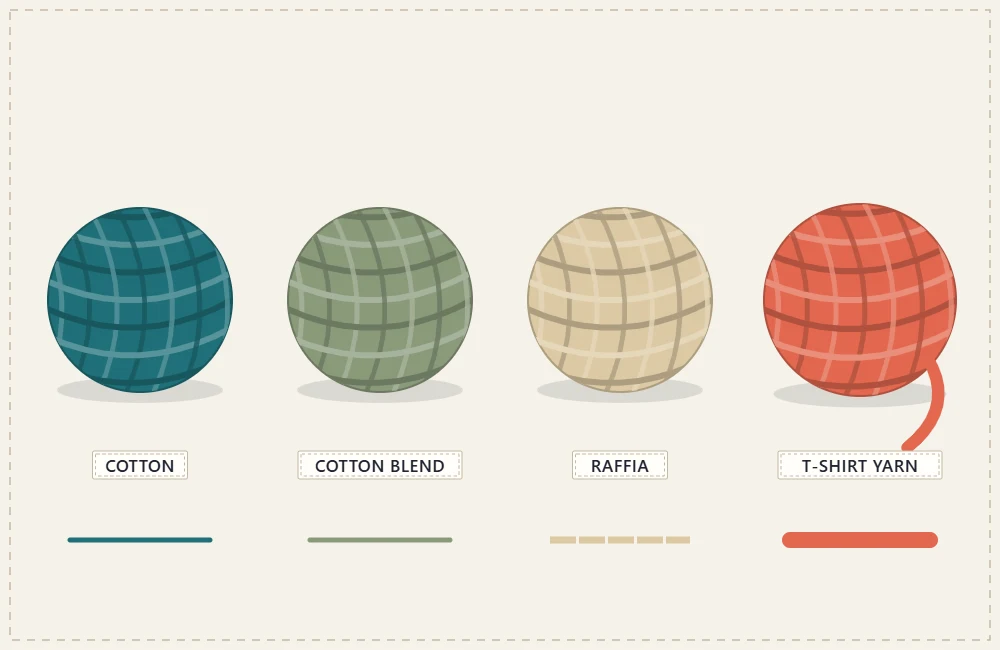
Cotton has almost no elasticity, takes dye well, washes easily and gets softer rather than fuzzier with use. Its drawbacks are weight (a large cotton tote is noticeably heavy even when empty) and the fact that it is hard on the hands when worked tightly.
Mercerized or unmercerized?
Mercerized cotton has been treated so the fibers are smoother, stronger and slightly glossy. It gives crisp stitches and a fabric that holds its shape, which suits structured totes, mini bags and anything with a visible texture. It is a little slippery, so knots and woven ends need extra attention.
Unmercerized cotton, often sold as kitchen or dishcloth cotton, is matte, softer and more absorbent. It is pleasant to work with and well suited to market bags and beach bags, but it relaxes more over time and fades faster.
Cotton blends
Cotton mixed with acrylic or polyester is lighter and easier on the hands, with a little more give. Cotton with linen or bamboo drapes more and has a dry, summery feel. A blend that is at least half cotton usually behaves closely enough to pure cotton for most bag patterns, provided the gauge is kept tight.
Other fibers and when they work
Raffia and paper yarn
Raffia-style yarn, whether made from plant fiber, paper or a synthetic, produces the stiff, straw-like fabric of summer clutches and structured baskets. It has no stretch at all and holds a shape without lining. It also creases and can be rough on the fingers. Paper-based versions should not be soaked, so check the care label before making a beach bag from it.
T-shirt yarn
This thick jersey strip, usually super bulky (#6) or jumbo (#7), makes a chunky bag in very few stitches. The fabric is dense and soft, and the bag ends up heavy. Thickness often varies along the strand, which shows in the stitches, and the jersey itself is stretchy, so use the smallest hook you can manage and keep handles short.
Macrame cord
Braided or twisted cotton cord in 3 to 5 mm thicknesses gives the firmest fabric of all, good for bucket bags and baskets that should stand on their own. It is stiff to work, and single-twist cord frays at the ends, so sew the ends down rather than only weaving them in.
Acrylic
Acrylic is light, inexpensive and comes in every color, and it is fine for small pouches, children’s bags and lined projects. For an unlined tote it has two weaknesses: it stretches under load and it pills where it rubs. Working one or two hook sizes smaller than the label and adding a lining makes it far more usable.
Wool
Wool is elastic and fuzzes with friction, which makes untreated wool a poor choice for an everyday crochet bag. The exception is deliberate felting, where a loosely worked bag in non-superwash wool is shrunk into a thick, solid fabric.
Comparison at a glance
| Yarn | Stretch | Body | Good for | Watch for |
|---|---|---|---|---|
| Mercerized cotton | Very low | Firm | Totes, mini bags, textured stitches | Slippery ends |
| Unmercerized cotton | Low | Medium | Market, produce and beach bags | Fading, slow relaxing |
| Cotton blend | Low to moderate | Medium | Everyday bags that should stay light | More give than pure cotton |
| Raffia or paper | None | Stiff | Clutches, structured summer bags | Creasing, water |
| T-shirt yarn | Moderate | Thick, soft | Chunky baskets and quick bags | Weight, uneven strand |
| Macrame cord | Very low | Very firm | Bucket bags, standing shapes | Stiff to work, fraying |
| Acrylic | Moderate to high | Soft | Small or lined bags | Stretch, pilling |
| Wool | High | Soft, springy | Felted bags only | Stretch, fuzzing |
Matching yarn weight to the bag
- Fine (#2) and light (#3): produce bags, drawstring pouches and delicate mesh. Slow to work, but the fabric is light and the holes stay small.
- Medium or worsted (#4): the all-round choice for totes, shoulder bags, crossbody bags and most first projects, typically with a US G-6 (4 mm) to US H-8 (5 mm) hook.
- Bulky (#5) and thicker: baskets, bucket bags and statement totes. Fast, but heavy when large.
For an open bag such as the mesh market bag, a smooth worsted cotton keeps the loops strong. For a big summer bag that will get wet, see the yarn notes in the crochet beach bag.
Tip
Whatever the fiber, bag fabric should be tighter than the label gauge. Start one hook size below the label recommendation and go smaller if you can see through the swatch when you hold it to the light.
Yarn is only half of a firm fabric. The stitch does the rest, and the densest options are compared in the guide to sturdy crochet stitches for bags.
How to estimate yardage
When a pattern is changed or there is no pattern at all, a weighed swatch gives a reasonable estimate.
- Crochet a 4 x 4 in (10 x 10 cm) swatch in the stitch and hook you plan to use, and weigh it on a kitchen scale.
- Work out the surface of the bag in square inches. For a flat tote, that is width x height x 2.
- Divide the surface by 16 (the area of the swatch) and multiply by the swatch weight. That is the weight of yarn in the body.
- Multiply by the yards per gram from the ball band, then add about 15 percent for the base, handles and ends.
As a worked example, take a tote 13 in (33 cm) wide and 14 in (36 cm) tall, with a swatch that weighs 5 g and a yarn sold as 85 yd per 50 g, which is 1.7 yd per gram. The surface is 13 x 14 x 2 = 364 square inches. Dividing by 16 gives about 23 swatches, or roughly 114 g, which is close to 195 yd. With the 15 percent allowance the estimate is about 225 yd (205 m). Round up to whole balls, and buy them together so the dye lots match.
If the choice of project is still open, the beginner’s roadmap to crocheting a bag sets out the options.
Frequently asked questions
Is acrylic yarn strong enough for a crochet bag?
It is strong enough not to break, but it stretches and pills. It works best for small pouches or for bags that are worked tightly and lined.
Does mercerized cotton stretch less than regular cotton?
Both stretch very little compared with acrylic or wool. Mercerized cotton tends to keep its shape slightly better over time because the fibers are smoother and stronger.
Can different yarn fibers be mixed in one bag?
Yes, as long as they are the same weight and have similar care needs. Keep the stretchier yarn away from straps and the base, where the load is highest.