Crochet Beach Bag: An Oversized Tote With a Mesh Top
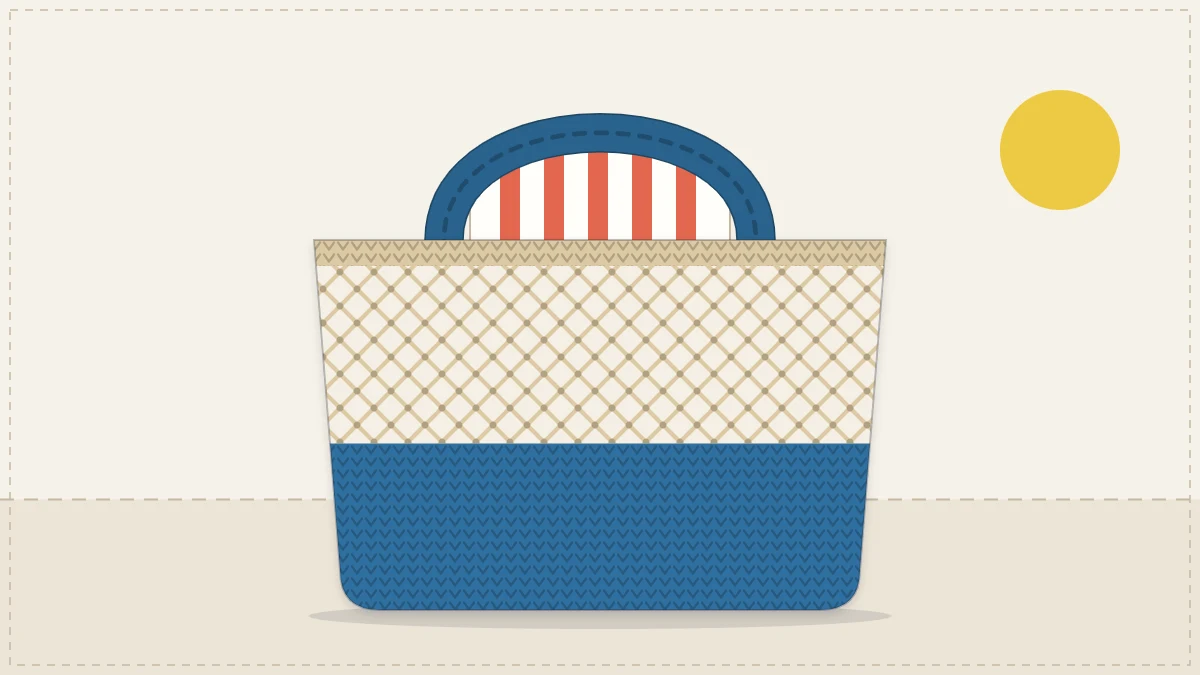
An oversized cotton beach tote worked in one piece: a solid oval base and lower body, a filet mesh upper that lets sand fall out, and rope-core handles.
Tutorial at a glance
Materials
- Worsted (#4) cotton, color A (sand): about 250 yd (230 m)
- Worsted (#4) cotton, color B (ocean blue): about 130 yd (120 m)
- US 7 (4.5 mm) crochet hook
- Cotton rope, 0.25 in (6 mm) thick: two 20 in (51 cm) pieces
- 4 stitch markers
- Yarn needle and scissors
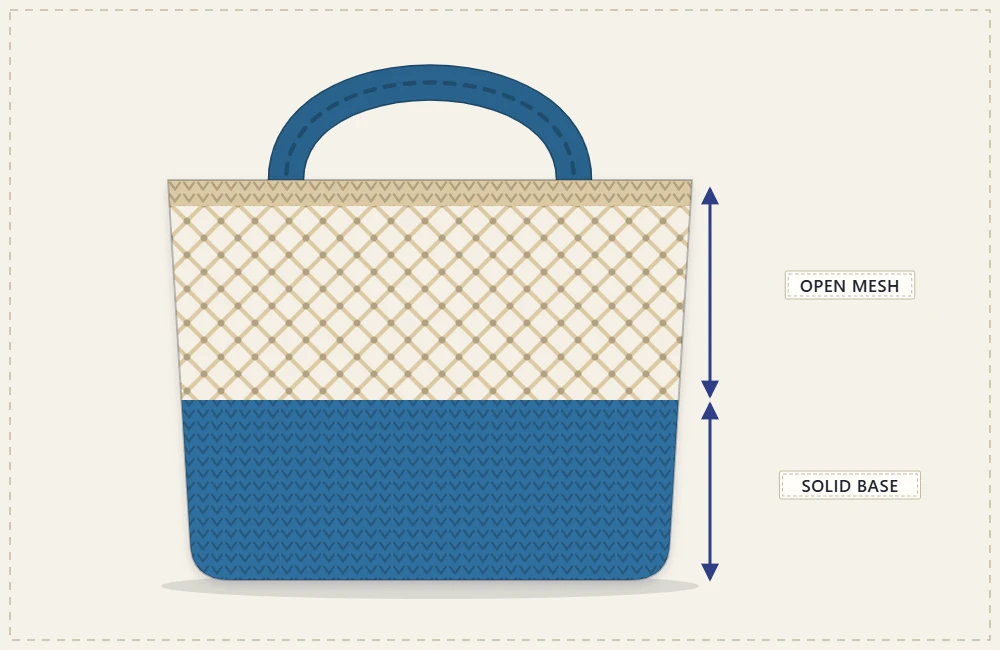
A beach bag has an unusual job description. It has to swallow towels, let sand fall back out, dry quickly after being dropped on wet ground and survive the washing machine. This oversized tote handles that with two fabrics: a solid base and lower body that keep small things in, and an open mesh upper that breathes.
It is worked in one piece from the base up, with no seams.
Materials and gauge
- Worsted (#4) cotton in two colors: color A (sand), roughly 250 yd (230 m), and color B (ocean blue), roughly 130 yd (120 m). These are estimates, so buy an extra ball of A.
- US 7 (4.5 mm) crochet hook
- Cotton rope, 0.25 in (6 mm) thick: two pieces of 20 in (51 cm)
- 4 stitch markers, yarn needle, scissors
Gauge: 14 single crochet (sc) and 16 rounds = 4 in (10 cm). In the mesh, 14 stitches (7 double crochet and 7 chain spaces) and 7 rounds = 4 in (10 cm). Bag gauge should be tighter than the yarn label suggests; if the fabric feels loose, go down a hook size. Why cotton suits a bag that gets wet is covered in the guide to the best yarn for crochet bags.
Finished size: about 18 in wide x 14 in tall (46 x 36 cm), excluding handles. To plan a different size, see the tote bag size guide.
Stitches used: chain (ch), slip stitch (sl st), single crochet (sc), double crochet (dc).
The oval base
With A, ch 52. The base is worked in a continuous spiral without joining; mark the first stitch of each round and move the marker up.
- 3 sc in the 2nd ch from the hook, sc in next 49 ch, 3 sc in the last ch; turn the work and continue along the other side of the chain, sc in next 49 ch. (104 sc)
- 2 sc in each of next 3 stitches, sc in next 49 stitches, 2 sc in each of next 3 stitches, sc in next 49 stitches. (110 sc)
- *[Sc in next stitch, 2 sc in next stitch] 3 times, sc in next 49 stitches; repeat from * once. (116 sc)
- *[Sc in next 2 stitches, 2 sc in next stitch] 3 times, sc in next 49 stitches; repeat from * once. (122 sc)
- *[Sc in next 3 stitches, 2 sc in next stitch] 3 times, sc in next 49 stitches; repeat from * once. (128 sc)
The base should lie flat and measure about 17 x 2.5 in (43 x 6 cm).
The solid lower body
- Sc in the back loop only of each stitch around. (128 sc) This round makes the fabric turn up sharply from the base.
- Sc in both loops of each stitch around. (128 sc)
Repeat the last round until the sides measure 5 in (13 cm) from the turning round, which is about 20 rounds. Sl st in the next stitch and fasten off A.
The mesh upper
Join B with a sl st in the same stitch as the last sl st. The mesh is worked in joined rounds, and it needs an even number of stitches; 128 gives 64 mesh squares.
- Ch 4 (counts as 1 dc and ch 1), skip next stitch, *dc in next stitch, ch 1, skip next stitch; repeat from * around, join with a sl st in the 3rd ch of the beginning ch-4. (64 dc and 64 ch-1 spaces)
- Ch 4 (counts as 1 dc and ch 1), *dc in next dc, ch 1; repeat from * around, join with a sl st in the 3rd ch of the beginning ch-4. (64 dc and 64 ch-1 spaces)
Repeat round 2 until the mesh measures 8 in (20 cm), usually 14 rounds. Fasten off B.
This is a filet-style mesh, with small square holes that let sand through but hold a rolled towel or a paperback. More open alternatives are compared in the guide to mesh stitches for bags.
The top band and handles
Join A with a sl st in the top of any dc.
- Ch 1 (does not count as a stitch here or below), sc in the same stitch, sc in next ch-1 space, *sc in next dc, sc in next ch-1 space; repeat from * around, join with a sl st in the first sc. (128 sc)
- Ch 1, sc in each stitch around, join. (128 sc)
- Repeat the last round. (128 sc) Fasten off.
Now position the handles. Lay the bag flat with the base folded along its foundation chain. Place a marker in the stitch at each side fold; the two markers should be 64 stitches apart. Rejoin A with a sl st in one marked stitch.
Handle rounds
- Ch 1, starting in the marked stitch, *sc in next 20 stitches, ch 70, skip next 24 stitches, sc in next 20 stitches; repeat from * once, join. (80 sc and 2 ch-70 loops)
- Ch 1, sc in each sc and in each chain around, join. (220 sc)
- Ch 1, sc in each stitch around, join. (220 sc)
- Repeat the last round. (220 sc) Fasten off and weave in all ends.
Tip
After the first handle round, hold the bag up by both chain loops. If a handle sits off center, pull that round back and move the marker a stitch or two; it is much easier to correct now than later.
Rope-core handles
Each handle is now a flat strip about 1 in (2.5 cm) wide. Lay a piece of rope along the inside of one strip, between the two points where the handle leaves the band. Fold the strip around the rope so its two long edges meet underneath, and whip stitch them together with A along the full length of the handle, catching the rope with the needle at both ends so it cannot slide. Repeat for the second handle.
The rope takes the weight, so the handles stay round and resist stretching. For doubled handles without rope, fold and stitch the strips the same way with nothing inside. Other handle constructions are covered in the guide to crochet bag handles.
What to expect when it is loaded
A big mesh bag changes shape when it is full, and that is normal.
- It gets longer and narrower. The mesh stretches downward under weight, so a loaded bag usually hangs a few inches lower than its flat measurement. Make the mesh section shorter if the bag should stay compact.
- Wet cotton is heavy. Damp towels stretch the mesh further; washing and drying flat brings most of the shape back.
- Small items escape through mesh. Keep keys and coins in the solid lower section or in a small pouch.
Watch out
Shake the sand out before washing, and dry the bag flat or stuffed with a towel. Hanging a wet cotton bag by its handles stretches it while it dries.
Frequently asked questions
Can this beach bag go in the washing machine?
A bag made of cotton yarn with cotton rope in the handles can usually be machine washed on a gentle cycle; check the yarn label first. Reshape it and dry it flat, not hanging by the handles.
Can the whole bag be made in mesh?
It can, but small items will slip through the lower part and the base will sag more. Keeping at least a few inches of solid fabric above the base gives a far more practical bag.
How can the bag be made bigger or smaller?
Change the foundation chain: every 7 chains added or removed changes the width by about 2 in (5 cm). Keep the final base round at an even number of stitches for the mesh, and re-center the handles from the side folds.