Crochet Tote Bag Sizes: A Practical Sizing Guide
Common tote dimensions from small to large, plus the simple arithmetic that turns a gauge swatch into a foundation chain, base rounds and handle length.

How big should a crochet tote be? The honest answer is “big enough for what goes in it, and a little smaller than you think”, because crochet fabric grows once it carries weight. The dimensions below are common starting points, followed by the arithmetic that turns any size into a foundation chain and a number of rounds.
Common tote sizes
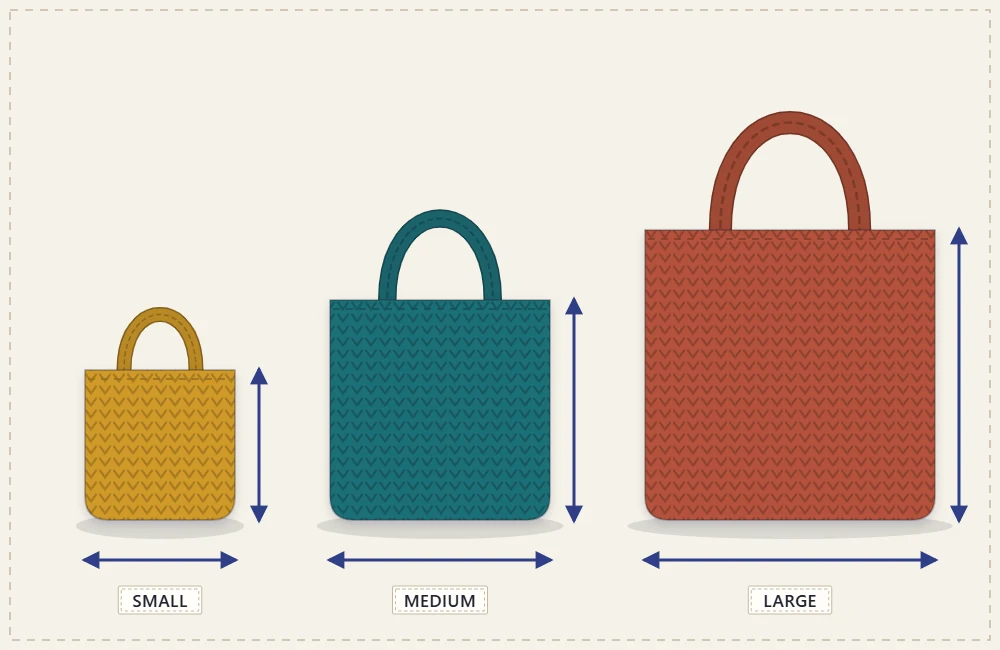
There is no official standard for tote sizes. These four cover most uses, and each can be nudged an inch or two in any direction.
| Size | Width | Height | Depth | Typical use |
|---|---|---|---|---|
| Small | 9 in (23 cm) | 10 in (25 cm) | 2 in (5 cm) | Wallet, phone, keys, a paperback |
| Medium | 12 in (30 cm) | 13 in (33 cm) | 3 in (8 cm) | Everyday carry, a water bottle, a light sweater |
| Large | 15 in (38 cm) | 15 in (38 cm) | 5 in (13 cm) | Groceries, yarn projects, a day out |
| Laptop or book | 14 in (36 cm) | 11 in (28 cm) | 2 in (5 cm) | A 13-inch laptop or large notebooks; measure yours first |
A tote that is wider than it is tall is easier to see into. One that is taller than it is wide carries better on the shoulder but swallows small things. Depth is what makes a tote stand up and makes room for bulky items.
Sizing for a laptop or books
Measure the actual object rather than trusting a screen size. Add about 1 in (2.5 cm) to the width and 1 in (2.5 cm) to the height for ease, and make the depth roughly the thickness of the object plus 0.5 in (1.3 cm). Too much spare room lets a heavy item slide around and pull the bag out of shape. A bag meant for a laptop also needs a lining or padding of its own, since crochet fabric offers very little protection.
From gauge swatch to stitch counts
Every size calculation starts with a swatch in the yarn, hook and stitch you will use. Make it at least 5 in (13 cm) square, measure across the middle 4 in (10 cm), and count stitches and rows. Divide each by 4 to get stitches per inch and rows per inch.
The examples here use a gauge of 14 single crochet (sc) and 16 rounds = 4 in (10 cm), which is 3.5 stitches and 4 rounds per inch.
A flat tote worked in rows
- Stitches across = width x stitches per inch. For 12 in: 12 x 3.5 = 42 sc, so chain 43 (one extra to turn).
- Rows = height x rows per inch, doubled if the panel is folded at the bottom. For 13 in: 13 x 4 = 52 rows per face, or 104 rows for one folded piece.
A tote with a rectangular base
For a base worked in rounds around a foundation chain, the chain is shorter than the base, because the rounds add length at both ends as well as width.
- Chain length = base width minus base depth. For a 12 x 3 in base: 12 – 3 = 9 in.
- Stitches in that length: 9 x 3.5 = 31.5, rounded to 32. Chain 33, one extra to turn.
- Base rounds: each round adds one row on each side of the chain, so rounds = depth x rows per inch, divided by 2. Here: 3 x 4 = 12, divided by 2 = 6 rounds.
- Stitches around: round 1 has twice the chain count, 66 sc. With square corners, each later round adds 8, so after 6 rounds the base has 66 + (5 x 8) = 106 sc.
- Check it: the distance around a 12 x 3 in base is 30 in, and 30 x 3.5 = 105 stitches. The count of 106 agrees, so the numbers hold.
- Side rounds = height x rounds per inch. For 13 in: 13 x 4 = 52 rounds.
The classic crochet tote pattern uses exactly this construction with a chain of 31 and a final count of 102 stitches, if you would like to see the method written out round by round. For circles and ovals, the increase rules are different and are covered in the guide to crochet bag base shapes.
Tip
Measure the base after its final round, before starting the sides. It is the last moment when changing the size costs minutes instead of hours.
How much stretch to allow
Crochet stretches most in the direction of the load, which for a bag means downward. Width usually changes little, and a loaded bag often gets slightly narrower as it gets longer. How much it grows depends on three things:
- Stitch: tight single crochet grows the least. Taller stitches grow more, and open mesh can lengthen dramatically.
- Fiber: cotton and other plant fibers barely stretch. Acrylic and wool give more and recover less well under constant weight. The comparison in best yarn for crochet bags goes through each fiber.
- Gauge: a hook one or two sizes below the label recommendation makes firmer, more stable fabric.
As a rough working allowance for a solid cotton tote, make the body about 0.5 to 1 in (1.3 to 2.5 cm) shorter than the height you want in use. For looser stitches or stretchier yarn, allow more, and test it: hang your swatch with a small weight clipped to the bottom for a day and measure again. A fabric lining removes most of the guesswork, because the lining carries the load instead of the stitches.
Watch out
Do not size a tote from the stitch counts of someone else’s pattern without swatching. Half a stitch per inch of difference in gauge changes the width of a medium tote by well over an inch.
Handle drop
Handle drop is the distance from the top of the handle, held taut, straight down to the top edge of the bag. It decides how the tote is carried.
| Carry style | Typical drop | Notes |
|---|---|---|
| In the hand | 4 to 6 in (10 to 15 cm) | The bag must clear the ground when your arm hangs straight |
| Crook of the arm | 6 to 8 in (15 to 20 cm) | Comfortable for small and medium totes |
| Over the shoulder | 9 to 11 in (23 to 28 cm) | Allow more over a thick winter coat |
To find your own number, loop a tape measure over your shoulder, hold both ends together where the top of the bag should sit, and halve the reading. Handles stretch more than the body does, so make them a little shorter than the measurement, usually by 1 to 2 in (2.5 to 5 cm) of total length for a solid single crochet handle.
The taller the tote, the shorter the drop it can take before the base bumps your hip or knee. A large tote with an 11 in (28 cm) drop hangs low; try it against your body with the tape measure before committing. Long single straps follow different rules, which are set out in the crossbody strap length guide.
Frequently asked questions
What is a good size for an everyday crochet tote?
Around 12 in wide, 13 in tall and 3 in deep (30 x 33 x 8 cm) suits most daily use. It holds a wallet, a bottle and a light layer without becoming heavy enough to stretch badly.
How many chains do I need for a 12 inch wide tote?
It depends on your gauge and construction. For a flat panel, multiply 12 by your stitches per inch and add one turning chain; for a base worked in rounds, subtract the base depth from the width before multiplying.
Should I make a crochet tote smaller than the size I want?
Slightly shorter, yes. Solid cotton single crochet usually lengthens a little under load, so taking roughly half an inch to an inch off the height is a sensible allowance. Width rarely needs adjusting.