Crochet Mesh Stitches for Bags: Net, Filet and V-Stitch Compared
Chain-loop net, filet mesh, V-stitch and solid fabric with eyelets compared for bags: how far each stretches, what falls through, and a short recipe for working each one.
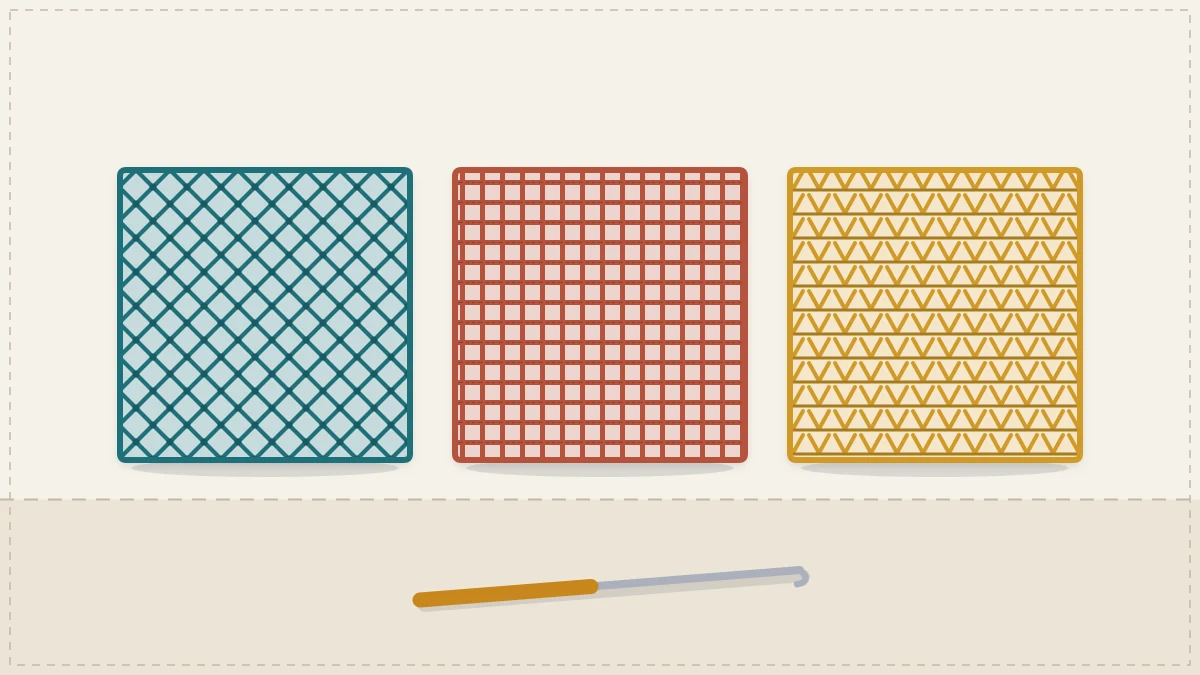
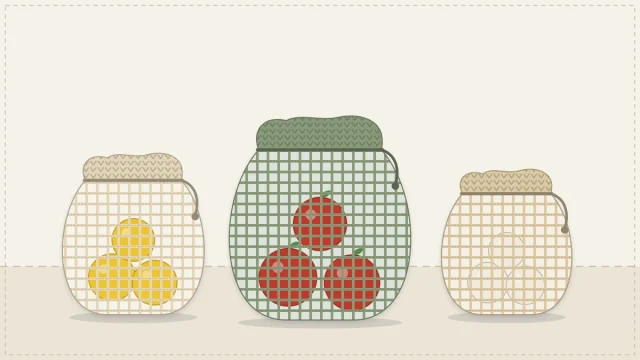
“Mesh” covers several quite different fabrics. A chain-loop net stretches to twice its width and lets a lime fall straight through; a filet mesh barely stretches and holds a clove of garlic. Choosing between them comes down to two questions: how much should the bag grow when it is loaded, and what is the smallest thing it has to keep inside?
Each of the four options below comes with a short recipe in US terms, for rows and for rounds.
The four options at a glance
| Mesh | Hole size | Stretch | What falls through | Good for |
|---|---|---|---|---|
| Chain-loop net | Large, opens into diamonds | Very high in every direction | Small fruit, keys, pens, coins | Market bags for large items |
| Filet mesh (dc, ch 1) | Small squares | Low to moderate | Only very small or thin items | Produce bags, beach bag sides |
| V-stitch mesh | Small to medium, V-shaped | Moderate, mostly lengthwise | Thin items such as pens | Totes that should look lacy but keep their shape |
| Solid with eyelet rounds | A few small holes | Low | Almost nothing | Everyday bags that need some airflow |
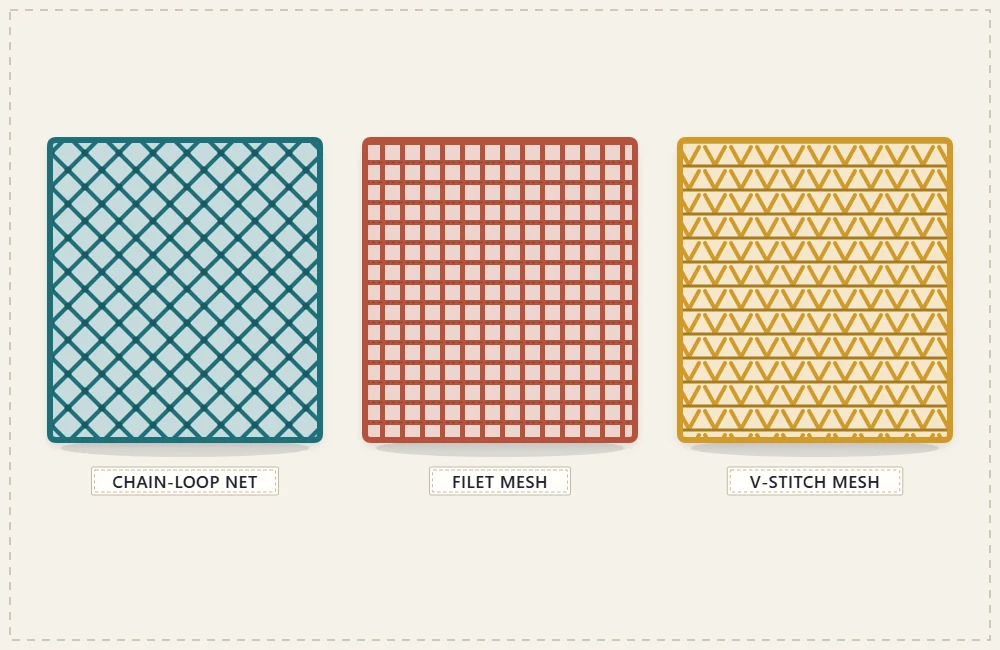
A useful rule: the more of the fabric that is made of chain, the more it stretches. Chains have nothing beside them to hold them in place, so they straighten under load. Stitches worked into stitches behave more like solid fabric.
Chain-loop (net) mesh
This is the classic string-bag fabric: loops of chain anchored with a single crochet (sc) in the loop below. It uses the least yarn of the four and expands the most, so the bag is small when empty and large when full.
In rows
- Chain (ch) a multiple of 4, plus 2.
- Row 1: Sc in the 2nd ch from the hook. [Ch 5, skip 3 ch, sc in the next ch] across. A starting chain of 22 gives 5 loops.
- Row 2: Ch 5 (counts as a double crochet plus ch 2), turn. Sc in the first ch-5 loop, [ch 5, sc in the next loop] across. Ch 2, double crochet (dc) in the last sc.
- Row 3: Ch 1, turn. Sc in the first dc, [ch 5, sc in the next ch-5 loop] across, working the last sc in the 3rd chain of the turning ch-5.
- Repeat Rows 2 and 3. Row 2 has one loop fewer plus a half loop at each edge; Row 3 returns to the full count.
In rounds
Start from a solid round with a multiple of 3 stitches. Sc in the first stitch, [ch 5, skip 2 stitches, sc in the next stitch] around, replacing the final loop with ch 2 and a dc in the first sc so the hook ends at the top of a loop. On later rounds, sc into each loop with ch 5 between. The crochet market bag pattern does exactly this on 72 stitches, for 24 loops.
Loop length is adjustable: chain 3 for a tight net, chain 7 for a very open one.
Filet mesh (dc, ch 1)
Filet mesh is a grid: one double crochet, one chain, repeated. Each dc sits on the dc below, forming columns, so the fabric holds its width well. The holes are one chain wide and one dc tall, small enough for most produce.
In rows
- Chain an even number.
- Row 1: Dc in the 6th ch from the hook (the skipped chains count as a dc, a ch 1 and the base under them). [Ch 1, skip 1 ch, dc in the next ch] across. A starting chain of 20 gives 9 dc and 8 spaces.
- Row 2: Ch 4 (counts as dc plus ch 1), turn. Skip the first space, dc in the next dc. [Ch 1, dc in the next dc] across, working the last dc in the 3rd chain of the turning chain.
- Repeat Row 2.
In rounds
Start from an even number of stitches. Ch 4 (counts as dc plus ch 1), skip 1 stitch, [dc in the next stitch, ch 1, skip 1 stitch] around, and join with a slip stitch (sl st) in the 3rd chain of the ch 4. On later rounds, ch 4, then [dc in the next dc, ch 1] around and join the same way. A round of 48 stitches gives 24 spaces, as in the small size of these crochet produce bags.
V-stitch mesh
A V-stitch is (dc, ch 1, dc) worked into one place. With two stitches for every chain, it is the sturdiest of the three true meshes. It stretches mainly lengthwise, as the Vs close up under weight.
In rows
- Chain a multiple of 3, plus 5.
- Row 1: (Dc, ch 1, dc) in the 6th ch from the hook. [Skip 2 ch, (dc, ch 1, dc) in the next ch] across until 2 chains remain. Skip 1 ch, dc in the last ch. A starting chain of 20 gives 5 V-stitches with one edge stitch at each side.
- Row 2: Ch 3 (counts as dc), turn. (Dc, ch 1, dc) in the ch-1 space of each V across. Dc in the top of the turning chain.
- Repeat Row 2.
In rounds
Start from a multiple of 3 stitches. Ch 4 (counts as dc plus ch 1), dc in the same stitch, [skip 2 stitches, (dc, ch 1, dc) in the next stitch] around, skip the last 2 stitches and join in the 3rd chain of the ch 4. On later rounds, sl st into the first ch-1 space, ch 4, dc in the same space, then work a V in each space around. A round of 60 stitches gives 20 Vs.
Solid fabric with eyelet rounds
When a bag has to hold small things but should still breathe, add rows of holes to an otherwise solid fabric. On a round of single crochet with a multiple of 3 stitches, work [sc in the next 2 stitches, ch 1, skip 1 stitch] around. On the next round, sc in every stitch and every ch-1 space, which restores the count. Repeat every 3 to 5 rounds.
The result behaves almost like plain single crochet. For fully solid, low-stretch fabrics, see the guide to sturdy crochet stitches for bags.
Choosing a mesh for a particular bag
- Groceries in large pieces: chain-loop net. Nothing else packs down as small.
- Loose produce: filet mesh, worked on a hook one size smaller than usual so the chains stay short.
- A bag carried by its own mesh, with no solid band: V-stitch, because the paired stitches spread the pull.
- Sand and wet towels: filet or V-stitch above a solid lower section, as in the crochet beach bag.
Watch out
Measure a mesh swatch twice: once lying flat and once hanging with a little weight clipped to the bottom edge. The second measurement predicts the finished bag, and with chain-loop net the two can differ a great deal.
Frequently asked questions
Which mesh stitch stretches the least?
Of the true meshes, filet mesh worked dc into dc holds its width best, and V-stitch is close behind. Solid single crochet with occasional eyelet rounds stretches less than either.
Does the hook size change how a mesh behaves?
Yes. A smaller hook shortens the chains, which shrinks the holes and reduces stretch. Going down one size from the yarn label's suggestion is a sensible starting point for any bag mesh.
Can two mesh stitches be combined in one bag?
They can, as long as the stitch count suits both. A count that is a multiple of 6 works for chain-loop net, filet mesh and V-stitch alike, so 60, 72 or 84 stitches make switching simple.