Crochet Bag Straps That Do Not Stretch Out
Seven ways to make a crochet bag strap that keeps its length, from changing the direction of the rows to backing the strap with ribbon, plus how to attach it securely.
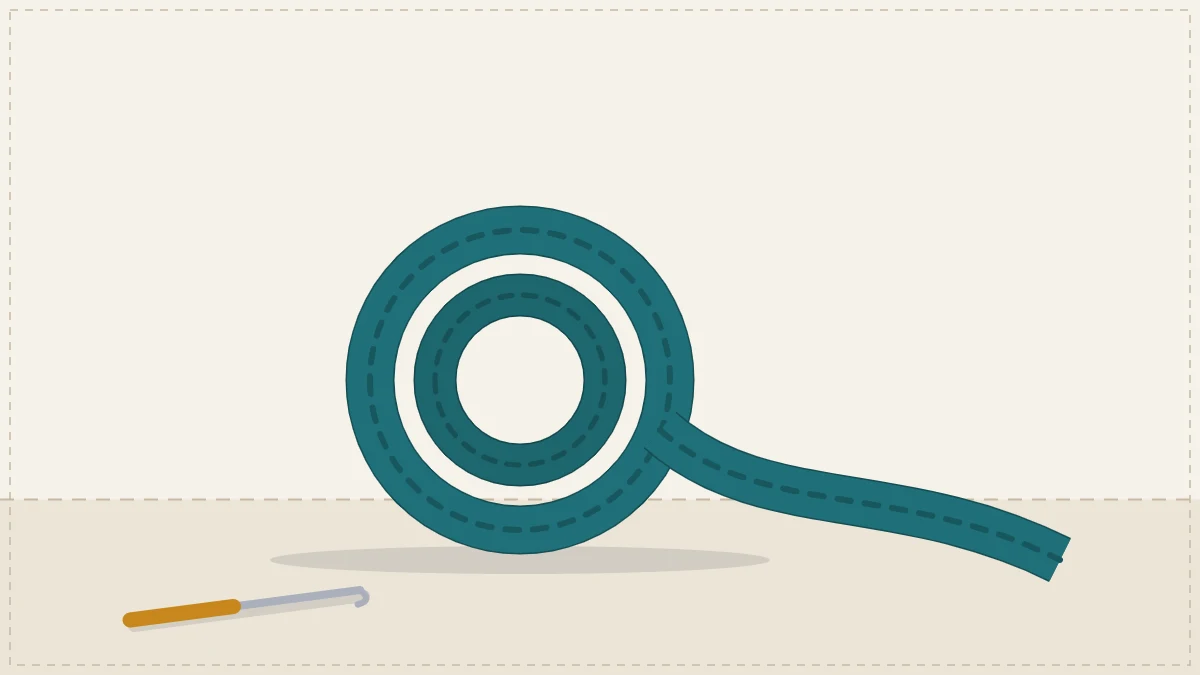
The strap is the part of a crochet bag most likely to disappoint. The body shares its load across hundreds of stitches, but a strap carries all of it on a strip a few stitches wide, and crochet lengthens when it is pulled. A strap that measured right on the table can hang several inches lower after a week of use.
The way a strap is built decides whether it grows a little or a lot.
Flat straps: long way or short way
A flat single crochet (sc) strap can be worked in two directions, and they behave differently.
Worked the short way
Chain (ch) 7, sc in the second ch from the hook and in each ch across (6 sc), then repeat “ch 1, turn, sc in each stitch across” until the strap is long enough. The length is easy to adjust as you go, but the weight of the bag pulls along the stacked rows, the direction in which single crochet gives most.
Worked the long way
Chain the whole length of the strap plus 1, sc in the second ch from the hook and in each ch across, then work 4 to 6 more rows of sc along that length (ch 1 and turn at the end of each row; the ch 1 does not count as a stitch). Now the pull runs along the rows, where the tops of the stitches form firm lines, and the strap grows much less.
The length is fixed by the first chain, so measure it against your body before continuing. Chain loosely, because a tight foundation makes the strap curve.
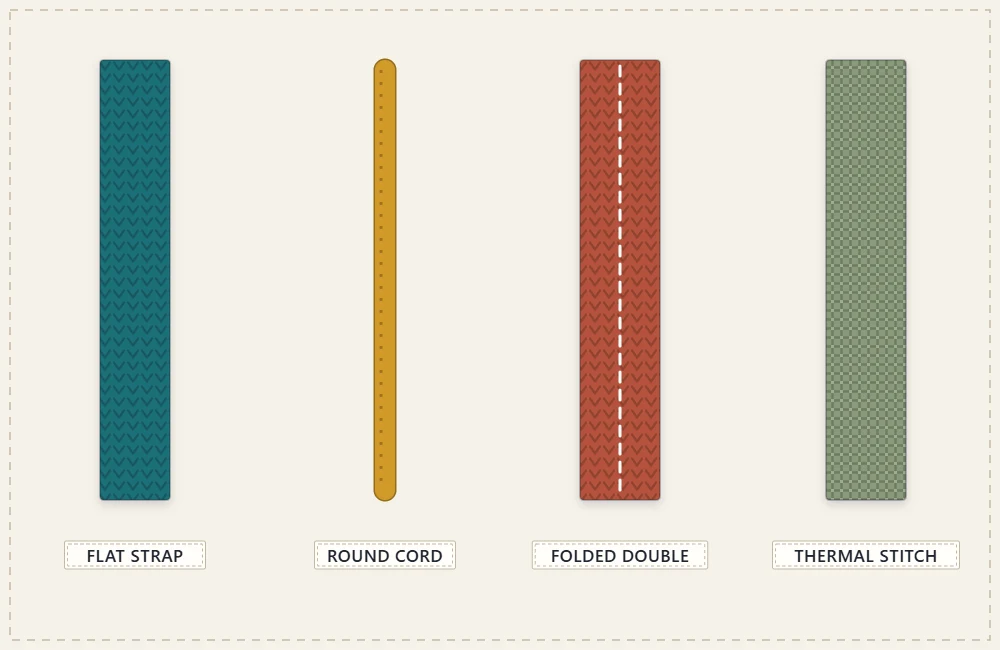
Folded double-thickness strap
Two layers stretch less than one and feel softer on the shoulder. Work a long-way strap twice as wide as you want it, for example 10 rows of sc for a finished width of 5 rows. Fold it in half along its length and close the long edge by working sc or slip stitch (sl st) through both layers, one stitch in each stitch along the edge.
Thermal stitch strap
Thermal stitch produces a double layer in one pass, because each sc is worked through a loop of the current row and a leftover loop of the row below. For a strap, ch 7 and work thermal stitch on 6 stitches to the length you need. It is slow and uses roughly twice the yarn, but the result is thick, flat and very stable. The full row-by-row recipe is in the guide to sturdy crochet stitches for bags.
Crocheted cords
For small bags, a cord is often better than a flat strap: it is round, compact and strong for its width.
Romanian cord
This flat, braid-like cord is made with single crochet worked into its own side loops.
- Ch 2, then sc in the first chain you made.
- Turn the work toward the left, like turning the page of a book. A single loop sits on the left edge. Insert the hook under it and make a sc.
- Turn the work the same way again. There are now two loops on the left edge. Insert the hook under both and make a sc.
- Repeat step 3 until the cord is long enough.
Always turn in the same direction; changing direction is what makes the cord twist.
Crochet i-cord
An i-cord is a narrow tube that looks knitted. Ch 3. Pull up a loop in the second ch from the hook and another in the third ch, so there are 3 loops on the hook. Slide the last two loops off the hook and pinch them at the base so they stay open. Yarn over and pull through the loop left on the hook. Put the next loop back on the hook, yarn over and pull through that loop only; do the same with the last loop. There are 3 loops on the hook again, and that is one round. Repeat for the length of the cord, then yarn over and pull through all 3 loops to finish.
A thin cord digs into the shoulder under weight, so keep both for phone bags, pouches and other light loads.
Slip stitch along the edges
A row of slip stitch has almost no give. Working one along each long edge of a finished flat strap acts like a pair of fixed-length threads holding it to size. Join the yarn at one end, sl st in each stitch (on a long-way strap) or in each row end (on a short-way strap) to the other end, fasten off, and repeat on the other edge.
Watch out
Slip stitches pulled tight will gather the strap. If it starts to pucker, rework that section more loosely or with a larger hook.
Backing a strap with ribbon or webbing
For a bag that will carry real weight, a woven backing is the surest fix, because woven fabric does not lengthen the way looped fabric does.
- Choose grosgrain ribbon or cotton webbing slightly narrower than the strap, so it does not show from the front.
- Cut it the length of the strap plus 1 in (2.5 cm), and fold 1/2 in (1.3 cm) under at each end.
- Lay the strap flat without stretching it and pin the backing along the wrong side.
- Sew down both long edges and across the ends with sewing thread in a matching color, using small stitches that catch the back of the crochet without coming through to the front.
Attaching a strap so it stays on
- Overlap, do not butt. Lay at least 1 in (2.5 cm) of the strap end against the inside of the bag rather than sewing it edge to edge with the rim.
- Sew a box. Stitch around all four sides of the overlapped area, then diagonally across it, so the load is spread over several rounds of the bag instead of one.
- Or crochet it on. Working the strap directly from stitches at the side of the bag leaves only one end to sew.
The fabric under the join matters as much as the stitching. Backing patches and extra anchor rounds are covered in how to reinforce a crochet bag.
Which method to choose
| Method | Stretch | Effort | Suits |
|---|---|---|---|
| Flat sc, short way | Highest | Low | Light bags, adjustable-as-you-go projects |
| Flat sc, long way | Moderate | Low | Most totes and shoulder bags |
| Long way with sl st edges | Low | Low to medium | Market bags and everyday totes |
| Folded double strap | Low | Medium | Wide shoulder straps |
| Thermal stitch | Very low | High | Heavier bags, short straps |
| Cord | Low | Medium | Phone bags and pouches |
| Ribbon or webbing backing | None to very low | Medium, needs sewing | Anything carrying books or a laptop |
Whatever the method, make an unbacked strap shorter than the length you want to end up with; the crossbody strap length guide explains how much to allow. Short hand-carry options are a separate subject, covered in crochet bag handles.
Frequently asked questions
Why does a crochet bag strap stretch so much?
Crochet is made of loops, and loops lengthen when pulled. A strap concentrates the weight of the whole bag on a few stitches, so the effect shows there first.
Can a strap that has already stretched be fixed?
Yes. Sew ribbon or webbing to the wrong side at the length you want, easing the crochet back onto it, or work a firm row of slip stitch along both edges.
How wide should a crochet shoulder strap be?
Roughly 1.5 to 2 in (4 to 5 cm) is comfortable for a tote or market bag. Narrow straps and cords are best kept for light bags, because they dig in under weight.