Crochet Mini Bag: A Small Structured Handbag Pattern
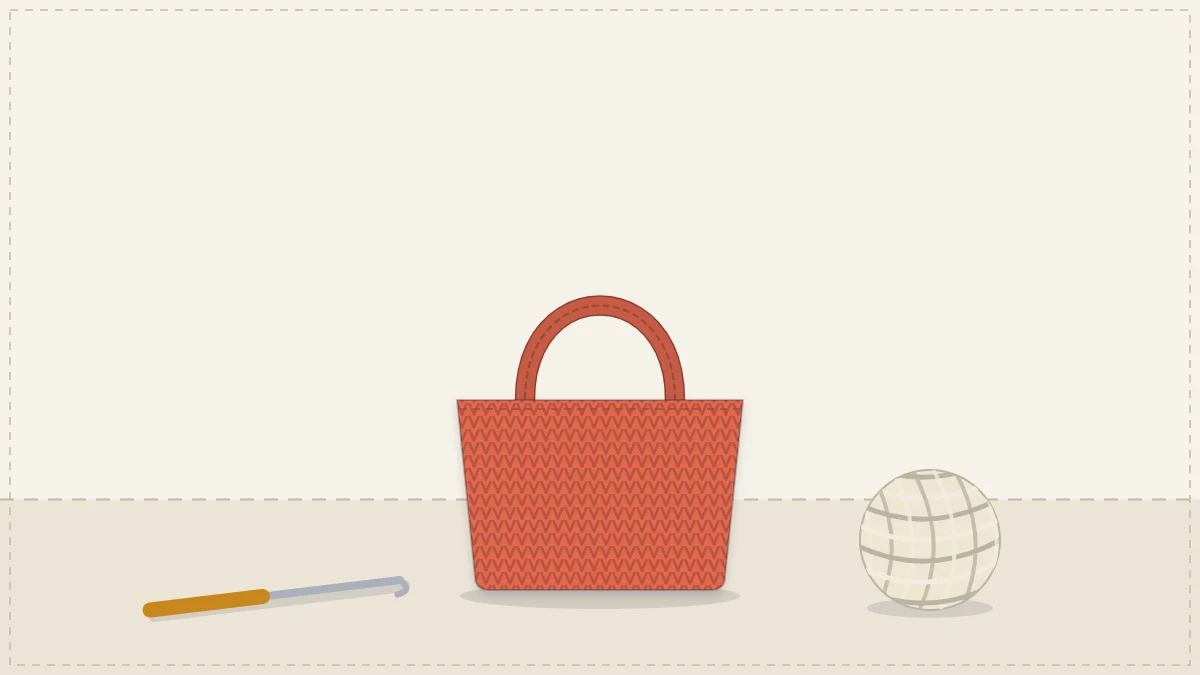
A tiny structured handbag with a rectangular base, firm single crochet sides and one short top handle, plus the methods that keep such a small bag stiff.
Tutorial at a glance
Materials
- Worsted (#4) cotton yarn, roughly 90 yd (82 m)
- US F-5 (3.75 mm) crochet hook
- Locking stitch markers
- Yarn needle
- Optional piece of plastic canvas for the base
- Optional two small D-rings and a chain or cord strap
- Scissors and tape measure
A mini bag has nowhere to hide. On a big tote a little slouch looks relaxed; on a bag 5 in (13 cm) wide, the same softness makes it look like a deflated pouch. The pattern itself is simple, a small rectangle and a tube of single crochet, and the real skill is keeping the fabric stiff enough to stand.
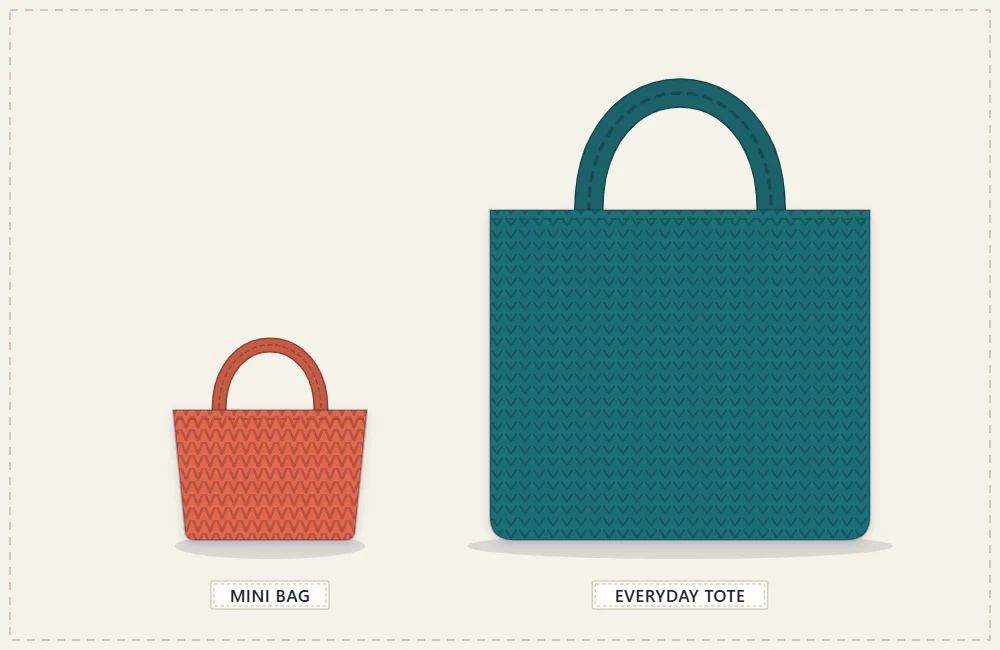
The finished bag is about 5 in wide, 4 in tall and 2 in deep (13 x 10 x 5 cm), with one short handle across the top.
Materials and gauge
- Worsted (#4) cotton, roughly 90 yd (82 m)
- US F-5 (3.75 mm) hook
- Locking stitch markers, yarn needle, scissors
- Optional: a piece of plastic canvas for the base, and two small D-rings for a detachable strap
Gauge: 18 single crochet (sc) and 20 rows = 4 in (10 cm). This is much tighter than a worsted label suggests. The fabric should feel dense and slightly stiff in your hand, and it should be a little hard to push the hook into each stitch. If the swatch drapes, go down another hook size.
Base
The base is worked in rows, which gives true square corners with no increases to track.
Chain (ch) 23.
Row 1: sc in the 2nd ch from the hook and in each ch across. (22 sc)
Rows 2 to 10: ch 1 (does not count as a stitch), turn, sc in each sc across. (22 sc)
The rectangle should measure about 5 x 2 in (13 x 5 cm). Do not fasten off.
Sides
The sides are picked up around all four edges of the base and then worked upward in a spiral.
Round 1: ch 1, turn, sc in each of the 22 sc across the last row. Rotate the base and work 10 sc evenly down the short edge, one in the end of each row. Rotate again and work 22 sc along the underside of the foundation chain. Rotate and work 10 sc up the second short edge, one in each row end. Do not join. (64 sc)
Check the arithmetic before going on: 22 + 10 + 22 + 10 = 64. No extra stitches are added at the corners, because the sides should turn straight up rather than spread outward. Place a marker in the first stitch of the round, and a second marker between the 5th and 6th stitches of each short edge to record the center of each end for later.
Round 2 onward: sc in each sc around, in a continuous spiral. (64 sc)
Repeat until the sides measure 4 in (10 cm) from the base, about 20 rounds.
Last round: slip stitch (sl st) in each sc around, keeping the stitches loose enough that the opening does not pull in. Join to the first sl st and fasten off. This round acts like a firm rim.
Tip
After the first three rounds, pinch a crease up each of the four corners with your fingers. Do it again every few rounds. Cotton remembers a fold, and four creased corners are what make the bag read as a box instead of a tube.
Handle
Ch 31.
Row 1: sc in the 2nd ch from the hook and in each ch across. (30 sc)
Rows 2 to 4: ch 1, turn, sc in each sc across. (30 sc)
Do not fasten off. Fold the strip in half lengthwise so the last row lies against the foundation chain, and sl st the two long edges together, working through one stitch of each layer at a time. Fasten off with a long tail. The result is a firm, rounded handle about 6 1/2 in (16.5 cm) long that holds an arch.
Sew one end of the handle to the inside of each short side at the center, overlapping the rim by about 1/2 in (1.3 cm). Use the markers from Round 1 as a guide, but confirm by eye at the top edge, since spiral rounds drift slightly. Stitch around the whole overlap, not just across it. A handle crocheted over cord, or a ready-made ring, also works at this size; both are covered in the guide to crochet bag handles.
How to keep a mini bag stiff
Use as many of these as the bag needs. They are listed roughly from least to most effort.
- Tight stitches. The small hook does most of the work. If your tension loosens as you relax into the rounds, the top of the bag will be softer than the bottom, so check the feel of the fabric as you go.
- A firm cotton. A smooth, tightly twisted cotton stands up better than a soft, loosely spun one. Acrylic and wool are usually too springy to hold a boxy shape at this size.
- A denser stitch. Working the sides in waistcoat stitch, where the hook goes into the center of each sc instead of under the top loops, gives an almost woven fabric. It is explained with the other options in sturdy crochet stitches for bags. It makes the fabric narrower, so swatch before substituting.
- A base insert. Cut a rectangle of plastic canvas slightly smaller than the base, about 4 3/4 x 1 3/4 in (12 x 4.5 cm), round off its corners and drop it in. It stops the bottom from bulging when the bag is carried.
- Lining with interfacing. A fabric lining backed with stiff interfacing turns the sides into firm walls. The full range of methods is in how to reinforce a crochet bag.
Watch out
Very tight crochet is hard on the hands. Work in short sessions, and if the hook is splitting the yarn on every stitch, the tension has gone past firm into too tight.
Optional long strap
To wear the bag across the body, sew a small D-ring inside each short side, just below the rim and beside the handle ends. Clip on a ready-made bag chain, or make a cord: chain until it measures about 44 in (112 cm), sl st back along the chain, and tie or sew each end to a ring. Rings keep the strap removable, so the bag can be carried by the handle alone.
Changing the size
The base sets everything. The starting chain is the width in stitches plus 1, the number of base rows sets the depth, and Round 1 of the sides is always twice the stitches plus twice the rows. A base of 26 sc and 12 rows, for example, gives 26 + 12 + 26 + 12 = 76 sc, a bag about 5 3/4 in (14.5 cm) wide. For something tall and narrow enough to carry a phone, the crochet phone bag is the better starting point.
Frequently asked questions
Why is this pattern rated intermediate when it only uses single crochet?
The stitches are basic, but working them tightly and evenly enough for the bag to stand takes some practice, and picking up stitches around the base is easier once you can read row ends.
Can the yarn be held double to make the bag stiffer?
Yes, two strands of a lighter cotton, such as DK (#3), worked together make a very firm fabric. The gauge will change, so swatch and recalculate the base from your own stitches per inch.
Will the bag soften after washing?
Cotton usually relaxes a little when washed. Reshape the bag while damp, stuff it with a small towel so the corners dry square, and let it dry completely before use.